If your portfolio contains assets held in a foreign currency, there is a risk that returns might be impacted by fluctuations in exchange rates. As a result, it can be worthwhile knowing how currency fluctuations impact returns. But what exactly is currency hedging, and is it worth the extra costs?
How do currency fluctuations affect portfolio returns?
As an Australian investor, if your portfolio holds assets in another country (for example, you own a managed fund that contains US shares) it is likely that these underlying assets are held in the local currency (e.g. USD for US shares). Returns on these investments will also be paid in the local currency, and then need to be converted back into Australian dollars (AUD). Thus, the value of the returns that you see will depend not only on the fund’s performance, but also on the exchange rate between AUD and the foreign currency.
This could result in positive or negative outcomes for Australian investors – if the value of AUD depreciates, you’ll end up getting more than the performance returns; but if AUD appreciates compared to the foreign currency, your returns will be worth less.
How much of a risk this poses depends on the volatility of the exchange rates between the two countries, and the timing of when you receive returns. In the short term, there can be significant exchange rate fluctuations. For example, in March 2020 AU$1 would get you US$0.58; by the same time the following year, it was US$0.78 (see chart below).
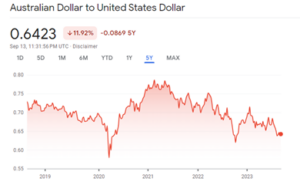
Source: Google Finance
This means that an Australian investor owning US investments during that time would have seen the value of their investments fall by 33% based on currency movement alone (before taking into account any performance of the actual investment). This shows that currency movements can significantly impact investment returns.
Investment experts generally agree that exchange rate fluctuations level out over the long term. Therefore, perhaps most important is the timeframe of the investment: how much exchange rates pose a risk depends on how long you hold the investment for.
How can currency hedging help to reduce exchange rate risk?
The risk of exchange rates impacting returns on foreign investments can be mitigated by implementing a hedging strategy. Investors are most likely to do this by choosing to invest in managed funds which use currency hedging over unhedged funds.
The risk from exchange rates can be hedged with forward contracts, which work by setting an agreed price at a date in the future thus removing any uncertainty or risk that the price might be higher. This strategy won’t result in higher returns for the investor, but it certainly takes away the risk that returns will be a lot lower if there’s a big change in currency valuation.
However, reducing currency risk comes at a price – the fees and costs of managed funds that are currency-hedged are generally higher. They may also be less tax efficient: hedged funds’ forward contracts are rolled monthly, and contracts that are profitable generally result in distributions of capital gains. This usually results in higher tax requirements than comparable unhedged funds.
Conclusions
Currency hedging can be effective at reducing risks posed by exchange rate fluctuations. This makes it particularly attractive to risk-averse investors who are keen to reduce portfolio volatility and avoid currency rates impacting on portfolio returns.
Exchange rate volatility can be a significant issue in the short term but tends to level out over a longer time period. Therefore, whether or not you choose a currency-hedged or an unhedged fund will most likely depend on your risk profile, the timeframe of your investment, and the extent to which your portfolio contains foreign assets.
If you would like to discuss currency hedging in your portfolio please contact me.
